

Space, Everyday Convenience, and a Strong Family-Rental Story
Orléans has long been one of Ottawa’s most practical east-end communities, especially for families, move-up buyers, and commuters who want more space without leaving the city behind. Known for its parks, schools, and established neighbourhoods, Orléans offers a suburban pace of life paired with access to employment hubs and major transportation routes.
What draws people to Orléans isn’t trend-driven growth or short-term buzz – it’s consistency. Homes here tend to offer larger lots, functional layouts, and the kind of storage, parking, and outdoor space that support everyday living. For buyers, Orléans often represents a step up in space and comfort. For investors, it delivers a reliable family-rental story built on long-term demand rather than turnover.
This deep dive into Orléans explores how the neighbourhood functions day to day, what the housing market looks like, and how the Orléans rental market performs for buyers and investors focused on durability over speculation.
Where Orléans Fits Within Ottawa
Orléans is located in Ottawa’s east end, stretching from the eastern edge of the Greenbelt toward the Ottawa River. Its size and internal variety mean that Orléans functions almost like a city within a city, with multiple residential pockets, shopping hubs, and recreation areas rather than a single core.
Highway access via Highway 174 connects Orléans to downtown Ottawa and employment areas, while transit routes – including LRT expansion – continue to improve east-west connectivity. This makes Orléans particularly appealing to commuters who want space at home without fully sacrificing access to the rest of the city.
For buyers comparing east-end options, Orléans often stands out as a neighbourhood where daily needs are met locally, reducing the need for frequent cross-city travel.

The Day-to-Day Feel of Orléans
Orléans has a noticeably lived-in, community-driven energy that comes from its size and variety rather than uniform planning. Some pockets feel busier and more connected to commercial corridors, while others are tucked into quieter residential streets that back onto parks, pathways, or green space. Daily life here often involves a mix of school drop-offs, evening walks along nearby trails, and errands handled close to home rather than long trips across the city. The pace of life is noticeably different from central Ottawa – less rush, more routine and considerably similar to the Barrhaven neighbourhood on the city’s west end.
Residents tend to structure their days around school schedules, community activities, and local errands. Parks, pathways, and recreation centres are heavily used, and many families stay in the same pocket of Orléans for years as their needs evolve.
This sense of continuity plays a major role in why family-friendly Ottawa neighbourhoods like Orléans continue to attract long-term residents rather than transient populations.
Schools, Parks, and Community Infrastructure
Schools are one of Orléans’ strongest demand drivers. The area offers access to a wide range of English, French, and Catholic school options, making it particularly appealing to families with long-term plans. Schools such as École secondaire publique Gisèle-Lalonde, Sir Wilfrid Laurier Secondary School, and St. Matthew High School serve different parts of the community, while elementary schools are woven directly into residential neighbourhoods.
Parks and green spaces are a defining feature of Orléans. Large areas like Millennium Sports Park and Cardinal Creek Community Park anchor neighbourhood life with sports fields, playgrounds, and walking paths, while smaller local parks ensure that most homes are within walking distance of outdoor space.
Community centres, libraries, and recreation facilities support organized programming year-round, reinforcing Orléans’ reputation as a place designed for families rather than short-term living.
Housing Mix and What Buyers Typically Get
The housing landscape in Orléans is defined by space and variety. Buyers will find a mix of detached homes, freehold townhomes, and newer subdivisions, along with some condo and stacked-town options near commercial corridors and transit routes.
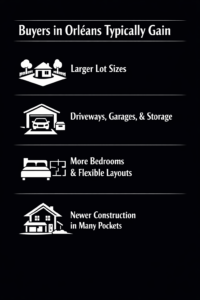
Compared to more central Ottawa neighbourhoods, buyers in Orléans typically gain:
- Larger lot sizes or usable outdoor space
- Driveways, garages, and storage
- More bedrooms and flexible layouts
- Newer construction in many pockets
Homes built from the 1990s onward make up a significant portion of the housing stock, though newer developments continue to expand Orléans’ footprint. This creates options for both buyers seeking move-in-ready homes and those comfortable with gradual updates.
What Drives Buyer Demand in Orléans
Buyer interest in Orléans is driven by function over form. Homes that offer practical layouts, finished basements, and adequate storage consistently attract attention, particularly from families planning to stay several years.
Parking is a key consideration, especially for multi-vehicle households. Yard access and safe walkability to schools or parks also factor heavily into decision-making. Cosmetic upgrades matter less here than usability and long-term comfort.
For move-up buyers leaving smaller or more central homes, Orléans often represents a lifestyle upgrade rather than a speculative purchase.
Orléans as a Family-Focused Rental Market
From an investment perspective, Orléans tells a very specific rental story among the top investment markets worth watching. The Orléans rental market is anchored by families and professional tenants who want space, stability, and access to schools and amenities.
Common tenant profiles include young families, government employees, healthcare workers, and commuters who prefer east-end living. Many renters stay for multiple years, which helps reduce vacancy and turnover costs.
Properties that perform best tend to mirror owner-occupier expectations rather than investor-driven layouts. Townhomes, detached homes, and well-designed units with multiple bedrooms are generally more resilient than smaller, high-density options.
What Helps Reduce Turnover in Orléans Rentals
In Orléans, tenant retention is closely tied to how well a home supports family routines and daily logistics. Rentals that function smoothly tend to outperform those optimized only for initial rent levels.
Strong-performing rentals often share these Orléans-specific traits:
- Driveway or garage parking that supports family and commuter needs
- Storage space for strollers, bikes, and seasonal gear
- Layouts that separate living, sleeping, and work-from-home areas
- Yard access or proximity to neighbourhood parks
- Locations within established school zones and walkable residential streets
In a family-oriented market like Orléans, stability is created by livability, not novelty.
Commute and Transportation Considerations
Transportation plays a meaningful role in shaping both buyer and investor decisions in Orléans. Highway 174 provides direct access toward downtown, while transit improvements continue to expand east-end connectivity.
Since Orléans covers a wide geographic area, commute times can vary significantly depending on pocket. Buyers and investors often benefit from narrowing their search radius based on daily travel patterns, school locations, and access to transit corridors.
Understanding these nuances can make a noticeable difference in long-term satisfaction and rental performance.

Watch-Outs to Keep in Mind
While Orléans offers many advantages, it’s not without trade-offs. Some pockets are more car-dependent than others, particularly those farther from transit or commercial hubs. Buyers should also pay attention to school boundary changes, traffic flow along major corridors, and differences in housing age across neighbourhood sections. To learn which pocket of Orléans might be right for you, partnering with an experienced realtor is your next best step. For investors, balancing purchase price with realistic rent expectations is key, especially as newer supply continues to enter the market.
Is Orléans the Right Fit?
Orléans tends to be a strong fit for buyers and investors who value space, schools, and long-term stability over proximity to nightlife or dense urban living. It may not appeal to those seeking compact condos or downtown walkability, but for families, commuters, and long-term renters, it remains one of the most dependable options in Ottawa’s east end.
Orléans includes a wide range of sub-neighbourhoods, and understanding how different pockets align with your priorities often requires looking beyond listings alone. Buyers and investors frequently weigh school zones, commute patterns, and walkability alongside housing options, and those comparisons are often clarified through neighbourhood-level discussions – such as a conversation with a knowledgeable realtor – that help translate lifestyle goals into the right search focus.
Lisa’s Tip 💡
In Orléans, neighbourhood pocket matters as much as the home itself. Two similar houses can perform very differently depending on school access, walkability, and commute patterns – factors that become more important the longer you plan to stay or hold the property.