

As the year winds down and investors across Ontario take stock of their portfolios, many are already shifting their focus toward what opportunities 2026 may hold. Late December is a natural time to reflect, reassess, and refine your investment strategy – and with the market stabilizing and rental demand remaining strong, value-add real estate opportunities are emerging as one of the most promising paths forward.
Whether you’re planning your first income property or looking to expand your portfolio in the new year, understanding where and how to add value will be a major advantage. The market heading into 2026 won’t reward speculation; it will reward strategy. With the right improvements – from basement suites to multi-unit conversions to smart small-town plays – you can create returns that grow long after this year comes to a close.
In the current market, simply buying and holding isn’t always enough to achieve the returns investors are looking for. Carrying costs remain elevated compared to previous cycles, and tenants expect more than ever when it comes to comfort, efficiency, and design. That means investors who can intelligently improve a property – not just maintain it – will stand out to both renters and future buyers.
Value-add real estate opportunities offer a level of control that pure appreciation cannot. Instead of waiting for market forces to boost a property’s value, you can take targeted steps to improve income, lower expenses, and increase desirability. These improvements compound over time, strengthening your overall portfolio and providing a buffer during market fluctuations.
With Ontario’s strong population growth, low vacancy rates, and ongoing housing shortage, well-executed value-add real estate opportunities have never been more relevant. High-quality rentals are in demand everywhere – from major cities to growing small towns – making 2026 a powerful year to rethink your investment approach.

Basement Suites: The Most Accessible Path to Immediate Cash Flow
Of all the value-add real estate opportunities available to Ontario investors, basement suites consistently rank as one of the best. They offer strong rental demand, relatively low renovation costs compared to full property overhauls, and the ability to dramatically boost a property’s income potential.
With many municipalities updating zoning and permitting rules to encourage secondary suites, investors now have more flexibility to create legal, fire-compliant units that appeal to renters seeking affordability. Young professionals, students, newcomers, and single tenants often gravitate toward basement apartments because they offer privacy, comfort, and lower rent than upper-level spaces.
For investors, a well-executed basement suite can:
- Reduce monthly carrying costs
- Increase property value
- Attract long-term tenants
- Strengthen cash flow, even in a higher-rate environment
Before taking on a basement conversion, it’s essential to understand local bylaws, building requirements, and permitted uses. Many municipalities make this information publicly available, and starting with a call to the local planning department ensures your project stays compliant from the beginning.
Multi-Unit Potential: Turning One Door Into Many
Another powerful strategy heading into 2026 is the conversion of single-family homes into duplexes or triplexes, depending on the property and zoning. Multi-unit conversions allow investors to multiply their rental income and significantly boost a property’s long-term value.
Cities like Hamilton, London, Kitchener-Waterloo, and parts of Ottawa have seen strong demand for multi-unit rentals, especially in walkable neighbourhoods near transit and employment hubs. These properties appeal to a wide range of renters, including multigenerational families, students, and professionals seeking more flexible living arrangements.
Multi-unit opportunities are especially attractive because they allow investors to diversify rental risk under one roof. Even if one unit becomes vacant, income from the other(s) helps support cash flow stability – something every investor values.
While conversions require upfront planning, the long-term payoff is often substantial. Investors who are willing to navigate the permitting process and work with qualified contractors can unlock properties with exceptional return potential.

Light Renovations: Small Changes, Big Impact
Not all value-add real estate opportunities require major overhauls. Light renovations – such as updating kitchens, refreshing bathrooms, improving flooring, or modernizing lighting – can instantly increase rental appeal and justify higher rents.
Tenants today expect spaces that feel clean, modern, and functional. Simple improvements like new hardware, energy-efficient fixtures, neutral paint, or refreshed landscaping can transform a property’s first impression.
Light renovations are also ideal for investors seeking out value-add real estate opportunities without taking on major construction risk. Many upgrades can be completed quickly between tenants or even while the home remains occupied, depending on the scope.
Another advantage: cosmetic improvements often provide some of the highest returns relative to cost. When done strategically, these updates help investors keep units competitive in fast-moving markets where tenant expectations evolve quickly.
Energy-Efficient Upgrades: Lower Expenses, Higher Value
Energy-efficient improvements are becoming one of the most underrated value-add opportunities across Ontario. With increased awareness around environmental sustainability and rising utility costs, tenants are paying closer attention to efficiency – and many are willing to pay more for homes that save them money month-to-month.
For investors, energy upgrades provide double value: they reduce operating expenses while strengthening rental appeal. Popular upgrades include energy-efficient windows, furnace replacements, heat pumps, better insulation, smart thermostats, and water-saving fixtures.
Some programs, such as Canada Greener Homes, have historically offered rebates and incentives for energy improvements (though programs evolve over time). Checking the current available incentives is a smart first step.
Beyond immediate savings, energy-efficient properties often appraise higher and experience stronger long-term tenant retention – two major wins for investors thinking strategically about their 2026 portfolio.
The BRRR Strategy: Still Effective When Executed Smartly
Buy, Renovate, Rent, Refinance, Repeat (BRRR) remains one of the most popular value-add strategies in Ontario investing – but with interest rate changes and tighter lending criteria, success today requires more precision.
The BRRR model can still work exceptionally well when:
- Renovations are budgeted accurately
- Rental demand is strong and predictable
- The after-renovation value (ARV) is supported by recent comparable
- Holding periods are flexible
In other words, BRRR works best when investors choose markets with solid fundamentals rather than speculative upside. Many mid-sized cities and emerging small towns provide ideal environments for this strategy, especially when paired with efficient renovations and high-ROI improvements.
Refinancing options depend heavily on lender policies and market conditions, so maintaining communication with a knowledgeable mortgage broker throughout the process is essential.
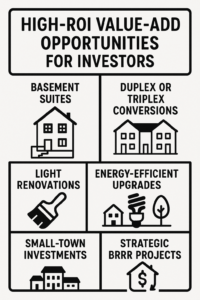
A Quick Breakdown of High-ROI Value-Add Real Estate Opportunities for 2026
- Basement suite or secondary unit conversions for strong rental income
- Duplex or triplex conversions to multiply cash flow
- Light renovations to increase appeal and rental rates
- Energy-efficient upgrades that reduce long-term expenses
- Small-town investments offering affordable entry and rising demand
- Strategic BRRR projects with carefully managed budgets
Looking Ahead: The Future of Value-Add Investing in Ontario
As Ontario heads into 2026, investors have an opportunity to build not just properties, but portfolios that truly perform. Value-add real estate opportunities allow you to shape returns proactively, navigate shifting economic conditions, and build long-term stability even in a competitive landscape.
The most successful investors in the coming years won’t be those who try to predict the perfect moment to buy or sell. They’ll be the ones who take a thoughtful approach – choosing the right markets, the right improvements, and the right long-term strategy.
Ontario’s real estate market continues to evolve rapidly, but the fundamentals remain strong: population growth, rental demand, and a desire for well-maintained, thoughtfully improved homes. When you combine these drivers with smart value-add decisions, the opportunities ahead are exceptional.
If you’re exploring value-add strategies or analyzing your next investment move, I’d be happy to help you map out the best approach for your goals.
Lisa’s Tip: Start With the Property’s Potential, Not Its Problems
Every investment property will have quirks, repairs, or outdated features – but experienced investors know that these “problems” are often the best pathways to profit. Instead of focusing on what a property is today, train your eye to see what it could become. The investors who can identify hidden potential now will be the ones celebrating meaningful growth in 2026 and beyond.