

As we enter the final month of the year, the December real estate market always brings a natural pause to Ontario’s – an exhale after months of activity, shifting headlines, interest rate speculation, and seasonal change. While December is traditionally a quieter moment, it also offers something uniquely valuable: clarity. When the pace slows, the trends become easier to see, and this year, the signals we’re getting from Ontario’s December market are already shaping early expectations for 2026.
Buyers and sellers across the province are watching the same indicators for the December real estate market: interest rates, affordability constraints, month-to-month demand shifts, and how quickly properties are moving in both urban and smaller-town markets. While no single month can predict the entire future, December consistently gives us some of the most reliable clues. That’s because the market at this time of year reveals consumer confidence levels without the noise of spring competition or fall pressure. People who buy or sell in December are doing so with strong intent, and their decisions help outline what’s coming next.
This year, the December real estate market in Ontario is telling a story of cautious optimism, persistent affordability challenges, and an increasingly strategic buyer pool – one that is likely to define the tone of early 2026. As we close out the year, let’s look at the signals that matter most.
Interest Rates: Stability Has Returned – and Buyers Are Paying Attention
After two years of rate hikes and uncertainty, the story heading into December is finally one of stability. The Bank of Canada held its key overnight rate steady through the fall, and that consistency has allowed both buyers and sellers to regain some footing. While the current rate environment still limits affordability for many first-time buyers, the lack of new increases has brought relief and created space for more confident planning.
The key question now is what this means for 2026. Historically, stable or declining interest rate periods have led to gradual increases in buyer activity, even before rates officially drop. We’re already seeing early hints of that trend across Ontario. In places like Ottawa, Kingston, Guelph, and Durham Region, mortgage pre-approval numbers began rising this fall – a sign that buyers are preparing in advance, waiting for the right moment to enter the market.
The Bank of Canada has signalled that future rate decisions will be based on inflation progress, which continues trending downward across many categories. While no major drops are expected before early or mid-2025, economists remain cautiously optimistic about more favourable borrowing conditions heading into late 2025 and early 2026. For buyers, this means a window of opportunity may be forming: prepare now, act strategically, and get ready to move when affordability improves.
Buyer Demand: Softer, But More Intentional Than Last Winter
Seasonally, December always reflects a slowdown in activity, but this year’s softness is different – it’s measured, intentional, and far more reflective of economic calculation than lack of interest. Buyers are shopping with their calculators out, not just their hearts, and that mindset is shaping inventory movement across the province.
Smaller and mid-sized Ontario towns – places like Collingwood, Carleton Place, St. Thomas, Belleville, and Bowmanville – are experiencing a different pattern. Here, buyers are still active in December, particularly among those relocating from larger cities to find better affordability. These communities offer more space and better value, and that appeal doesn’t disappear with colder weather. In fact, these markets often see some of their most serious buyers in December because competition is reduced, and sellers tend to be more flexible.
Throughout the province, there’s a noticeable rise in “wait-and-see” buyers: people who have completed mortgage pre-approvals, researched neighbourhoods, and aligned their budgets, but are waiting for the right price or interest rate environment. These buyers will play a major role in early 2026. Once rates begin trending down – or even once the Bank of Canada indicates that cuts are officially on the horizon – they may re-enter the market quickly, adding upward pressure to demand as the year unfolds.

Affordability: Still Challenging, But Stabilizing in Key Areas
Affordability remains the defining issue for Ontario’s housing market, and December’s numbers underscore that reality. Yet there’s a notable difference compared to this time last year: affordability isn’t steadily eroding anymore. In many areas, price adjustments and stabilized rates have created a plateau that’s helping buyers understand their true range with more clarity.
Ontario doesn’t operate as a single market – its affordability picture varies widely by region. Toronto and parts of the GTA remain challenging for first-time buyers, with entry prices and carrying costs still elevated. However, nearby communities like Oshawa, Hamilton, Cambridge, and Kitchener-Waterloo are offering more approachable entry points, especially for buyers who are flexible on commute times or property type.
Smaller Ontario markets – those outside the traditional commuter belts – are where affordability shifts become the most meaningful. Towns with strong local growth and infrastructure investment will continue gaining momentum in 2025 and into 2026 as buyers prioritize lifestyle, space, and long-term value.
Even though affordability challenges remain, the December real estate market data suggests that stability is returning, which is often the first step toward improved conditions for buyers.
Seasonal Patterns: December’s Market Is Quiet – But Revealing
December always brings a certain calm to the real estate landscape, but within that calm are important clues. Homes listed this month typically belong to sellers who need to sell or who are motivated by life changes – relocation, downsizing, or pre-construction timelines. These sellers tend to be realistic about pricing and more open to negotiations, which is why December can be a surprisingly productive buying month for those ready to act.
As the December real estate market unfolds, the ratio of listings to active buyers provides an early view of what early 2026 may look like. This year, that ratio suggests a more balanced market ahead – neither heavily buyer-nor seller-dominated – and that balance tends to favour steady price growth rather than dramatic swings.
Looking Ahead: What December’s Trends Suggest for 2026
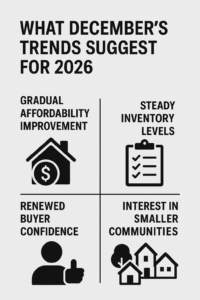
While December alone cannot predict the entire trajectory of the next year, its patterns have historically been dependable indicators of what’s coming. Based on this year’s closing trends, Ontario’s 2026 market will likely be shaped by four major forces:
- gradual affordability improvement
- renewed buyer confidence
- steady inventory levels across most regions
- increased interest in smaller communities offering better value
We may also see a shift in how buyers approach timing. Rather than rushing into the spring market, many will prioritize preparation – mortgage readiness, and long-term financial planning. This intentional approach helps create more stable markets with fewer dramatic price swings.
Sellers entering 2026 will likely benefit from this stability as well. Well-priced homes in desirable locations should continue to attract strong interest, especially as buyer confidence grows with clearer rate expectations. However, listings that are overpriced or not aligned with current demand may sit longer, reinforcing the importance of strategy and presentation.
For buyers, the message is clear: the groundwork you lay now matters. Whether you’re thinking about making a move in mid-2025 or waiting for improved affordability in 2026, the December real estate market conditions underscore the value of early preparation. Even if you’re not ready to purchase immediately, this is the ideal time to understand your numbers, organize finances, and explore communities that match your lifestyle goals.
A Quick Look at Ontario’s Key December Signals
- Interest rates are stabilizing, setting the stage for potential improvement heading into 2026
- Buyer demand is soft but intentional, with many preparing quietly behind the scenes
- Affordability remains challenging but is no longer in steady decline across key markets
- Smaller Ontario communities continue to attract buyers seeking better value.
- December’s quieter pace reveals a balanced market forming for early 2026
Lisa’s Tip: Use December to Plan, Not Pause
While it’s tempting to put real estate on hold during the holidays, December is actually one of the best months to plan for your next move. The December real estate market is quieter, mortgage professionals have more availability, and you can enter the new year with a clear sense of what’s possible. Whether you’re aiming to buy in 2025 or waiting for the right moment in 2026, the preparation you do now will set the stage for a confident, well-timed decision.
If you’d like a customized breakdown of trends in your specific city or want help mapping out your 2025–2026 buying strategy, I’m always here to chat.